
Electric Motor Bearing Selection: A Five-Parameter Technical Guide
Precision alone does not make an electric motor run better.
Choosing a bearing for an electric motor means fixing five numbers — dynamic load, clearance class, precision grade, ring and ball material, and sealing arrangement — against the duty the machine actually sees, rather than ordering the tightest grade in the catalog. Plants that work this way report fewer motor failures and a lower lifetime cost of ownership. It is technical discipline applied to a purchased component, not a matter of brand loyalty or copying the last specification sheet.
I spent years on the buying side before I crossed over to supply, walking the halls at Hannover Messe and believing I could read a quotation better than anyone in the room. One of those years I approved a run of 6310-2RS deep groove units for the motor assembly line at a plant in Lombardy — P0 tolerance, CN clearance, perfectly standard on paper. Within a quarter the motors were howling, vibration had climbed, and half the batch went for scrap. The tear-down report was unkind: those motors ran hotter than our assumptions allowed, thermal growth ate every micron of internal clearance, and the CN bearings were effectively running with no play at all. C3 was the correct call. So was measuring the real housing temperature instead of inheriting the previous supplier's specification. That report still sits in a folder on my desk. These days the first three questions I raise on any motor bearing inquiry are the operating temperature, the speed curve, and whether a proper L10 calculation had ever been run, or the figure was simply lifted from a catalog.
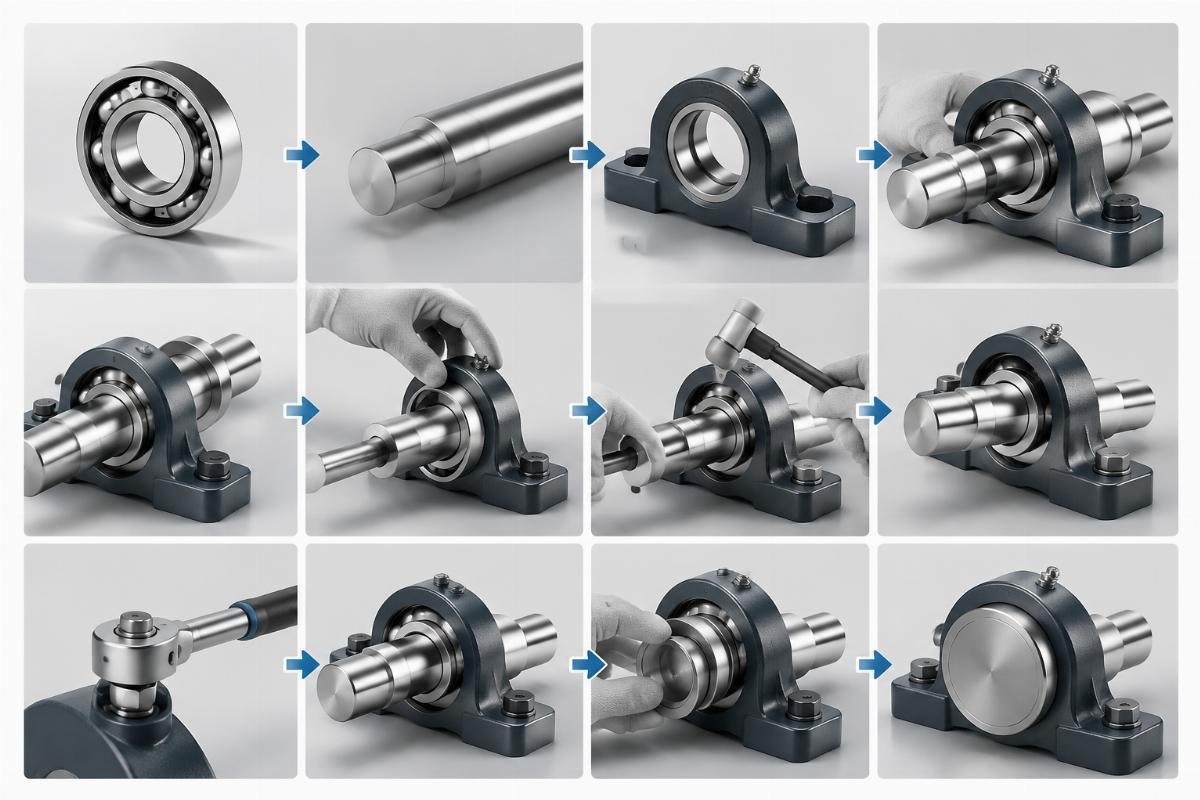
Each parameter interacts with the others inside a given motor, and that interplay is exactly why a documented method outperforms intuition.
- Why Bearing Choice Sets the Reliability Ceiling of an Electric Motor
- Which Five Parameters Decide an Electric Motor Bearing Specification
- How Do Bearing Types Map to Different Motor Duties
- How to Validate a Motor Bearing Choice Against Real Application Data
- Sourcing Motor Bearings from China with Traceability You Can Audit
- Final Take
Why Bearing Choice Sets the Reliability Ceiling of an Electric Motor
No single component takes more motors out of service than the bearing. In industrial plants, bearing-related trouble accounts for a large share of unplanned stoppages, and a single idle hour can cost the operator tens of thousands of dollars in lost output. A correctly chosen bearing protects that uptime by carrying radial and axial load, holding friction down, and keeping alignment stable while the motor works under stress.
| Performance Indicator | Impact of Proper Bearing Selection |
|---|---|
| Motor Efficiency | Reduces friction coefficient noticeably compared to mismatched bearings |
| Service Life | Extends average motor lifespan from tens of thousands to substantially more operating hours |
| Vibration Levels | Maintains vibration within ISO 1940-1 balance standards, reducing noise and component wear |
| Temperature Rise | Controls operating temperature within a narrow band above ambient, preventing insulation breakdown |
A steel mill in Europe came to us with repeat failures on its continuous casting motors. Maintenance had standardized on high-precision P4 bearings in the belief that tighter tolerances bought longer life. Our review found moderate loads and manageable vibration — duty a P5 grade handles comfortably. We moved the position to a clearance-matched P5 set running a C4 clearance group with grease rated for high temperature. Failures stopped, bearing spend per unit fell noticeably, and those motors now run well over a year between service stops.
Five checkpoints drive the specification, and they are worked in order:
- Load Analysis – Run the dynamic load calculation from motor rating and duty cycle to establish the C value required
- Speed Capability – Test the bearing speed factor (dn) against the motor's top RPM and running temperature
- Environmental Assessment – Record temperature extremes, moisture exposure and contamination risk at the mounting position
- Lubrication Compatibility – Match the bearing design to lubricant type and to the replenishment interval you can sustain
- Installation Requirements – Weigh mounting method, shaft tolerance and the alignment you can realistically achieve
Which Five Parameters Decide an Electric Motor Bearing Specification
Precision grade sits well down the list of what actually matters. Buyers fixate on the tolerance class, yet in our engineering reviews clearance and material selection move service life far more in ordinary motor duty. Getting those two right lets a bearing absorb thermal growth, shaft deflection and load swings without distress.
| Selection Parameter | Common Mistake | Engineering Best Practice |
|---|---|---|
| Dynamic Load Rating | Selecting based on nameplate power alone | Calculating using P = (kW × 9550)/n formula for actual load conditions |
| Clearance | Defaulting to standard C3 clearance for all applications | Specifying C2 for tight tolerance motors, C3 for general use, and C4 for high-temperature applications |
| Precision Grade | Automatically specifying P4 for all industrial motors | Using P5 for standard applications, reserving P4 only for high-speed (>3000 RPM) or low-vibration requirements |
| Material | Choosing standard steel for all environments | Selecting 440C stainless steel for moisture-prone areas and ceramic hybrids for high-temperature applications |
| Sealing | Using contact seals for all applications | Specifying non-contact seals (2Z) for high-speed motors and triple-lip seals (2RS) for contaminated environments |
Take a 7.5 kW motor running at 1750 RPM: the torque figure works out as P = (7.5 × 9550)/1750 = 40.9 Nm, which points to a bearing dynamic rating near 18 kN and steers the choice toward deep groove ball bearings in the 6309 or 6210 family. Then that same motor went into a food processing plant with washdown cleaning, and we specified 440C stainless rings with Viton seals in place of ordinary 52100 steel. The load conditions were identical; the service life was not.
Working through those five parameters follows a fixed order:
- Calculate Dynamic Load – Combine motor power (kW), speed (RPM) and the application factor to size the bearing rating
- Determine Clearance Class – Pick C2, CN, C3 or C4 from the expected temperature rise and the shaft fit
- Select Precision Grade – P5 covers standard duty, P4 is for high-speed shafts, P6 suits low-torque positions
- Specify Material – 52100 for general service, 440C stainless where corrosion attacks, ceramic hybrids for extreme heat
- Choose Sealing Configuration – Balance protection against friction: 2RS where contamination is present, 2Z where speed rules
How Do Bearing Types Map to Different Motor Duties
Deep groove ball bearings are rarely the wrong answer, but they are not always the right one. They dominate motor installations by volume, yet our application records show spherical roller bearings cutting maintenance spend noticeably on heavy-duty motors above 100 kW, even at a higher purchase price. What settles the type is the load character of the specific duty, never a default.
| Bearing Type | Key Advantages | Ideal Application Scenarios |
|---|---|---|
| Deep Groove Ball | Low friction, high speed capability, cost-effective | General-purpose motors, pumps, small compressors (up to 50kW) |
| Angular Contact | Handles combined radial-axial loads, high precision | CNC spindle motors, servo drives, high-speed blowers |
| Spherical Roller | Self-aligning, high radial load capacity | Wind turbine generators, large induction motors, crushers |
| Cylindrical Roller | High radial load capacity, low friction | High-torque motors, gearboxes, traction motors |
| Thrust Ball/Roller | Axial load handling, compact design | Vertical motor shafts, elevator motors, steering systems |
A wind energy OEM asked us to review main shaft bearings for 3 MW turbine generators. The first specification named standard cylindrical rollers, but our analysis found shaft deflection those bearings could not tolerate under gusting wind loads. We proposed 230/500 CA/W33 spherical rollers in P5, with a C3 clearance group and reworked internal geometry, to tolerate the misalignment. Failures fell sharply through qualification testing, and the account moved to a long-term supply agreement. The modified clearance allowed thermal growth while holding preload stable across the operating range.
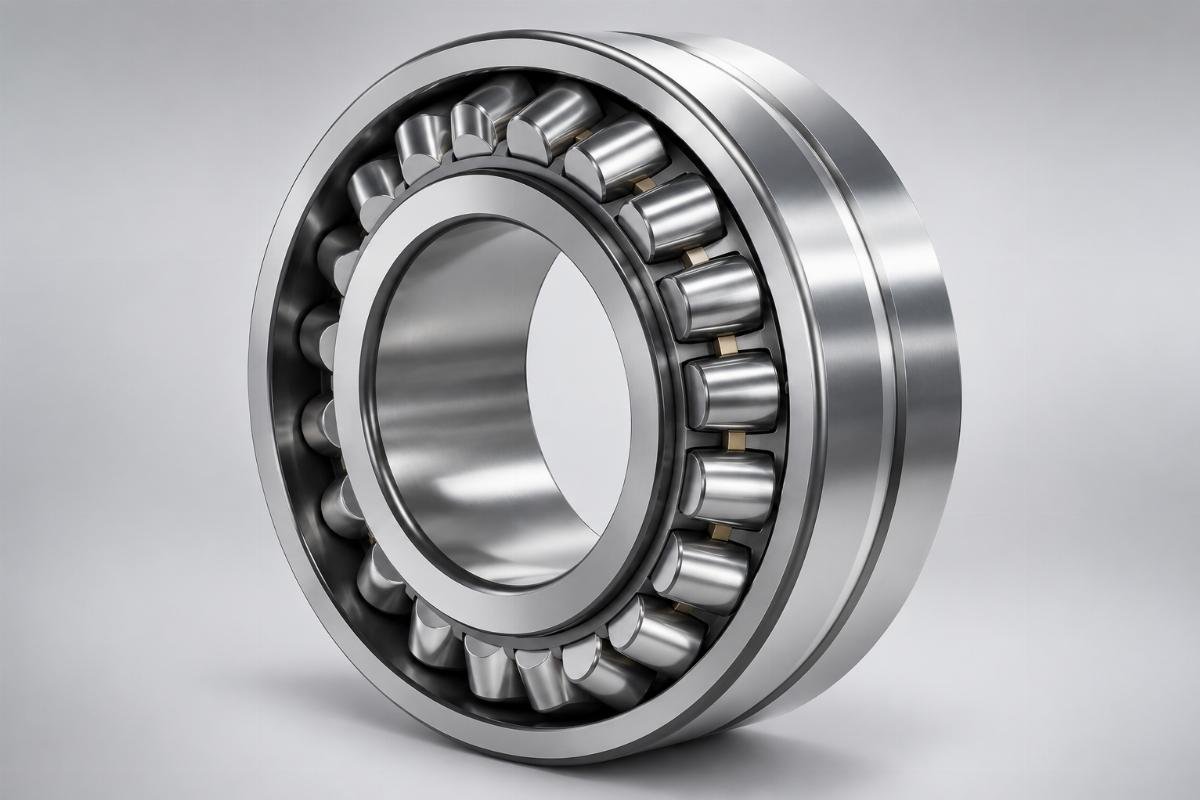
Type selection by duty follows a short set of rules:
- Deep Groove Ball Bearings – Standard horizontal motors where radial load stays balanced and shaft speed remains under 6000 RPM; covers the 6309, 6210 and 6310-2RS families
- Angular Contact Bearings – Where axial load is a significant fraction of radial load, or shaft speed passes 3000 RPM
- Spherical Roller Bearings – Motors above 100 kW, vertical mounts, or any position where misalignment is possible; the 230/500 CA/W33 is the reference case
- Cylindrical Roller Bearings – High-torque drives with limited radial space and a stiff shaft
- Thrust Bearings – Where axial load dominates, as on vertical shaft motors
How to Validate a Motor Bearing Choice Against Real Application Data
Correcting parameters, not changing brands, is what removes failures and lowers cost. Our work across regions and sectors keeps producing the same pattern: results improve once the team matches specification to measured duty instead of inheriting a catalog assumption.
The European steel mill case is the clearest illustration. Those casting motors ran P4 precision bearings that the real load and speed never justified. Maintenance assumed precision bought life. In practice the tighter internal geometry ran hotter, and the CN clearance was gone once thermal expansion took hold. A P5 grade with a C4 clearance together with high-temperature grease matched the thermal profile the application actually had. Failures stopped, cost per bearing dropped, and service intervals stretched past every earlier benchmark.
The food plant case shows what material choice does to life. A standard 7.5 kW motor in washdown duty kept failing with conventional 52100 bearings, because moisture and chemical cleaners attacked the steel. We moved the position to 440C stainless with Viton seals — same envelope, same ratings — and service life improved sharply. Stainless rings resisted corrosion and the Viton lips held up under the cleaning regime.
The wind OEM case shows the value of engineering for the application. Standard cylindrical rollers could not live with the shaft deflection that variable wind load produces on a 3 MW generator. The 230/500 CA/W33 solution in P5, carrying a C3 clearance group and reworked internal geometry, let the bearing self-align as the load moved. Failures dropped dramatically during qualification testing and validated the approach.
What ties the three cases together is method: in each one the team worked from measured operating conditions — temperature profile, load variation, environmental exposure — rather than copying a specification from an earlier project or accepting a catalog default.
Sourcing Motor Bearings from China with Traceability You Can Audit
A perfect specification is worth nothing if the supply chain cannot deliver it. Selection only pays off when the bearing that physically arrives matches the paperwork, and that depends on a supplier offering batch-level traceability, inspection per lot, and fast dispatch on both common and rare designations.
As a supplier of compatible replacement bearings for FAG/Schaeffler-series interchange applications, we hold batch-level traceability on every consignment. Each unit carries a batch number we verify against factory and heat-lot records, so the P5 class, the C3 clearance and the material certificates written into your engineering documents are what physically ships. That coverage runs across the whole interchange range: P0 to P4 precision classes, C2 to C4 clearance options, deep groove ball, cylindrical roller, tapered roller, spherical roller, thrust and self-aligning types, plus stainless, ceramic hybrid and sealed (2RS/2Z) variants.
Volume buyers at OEM plants get one thing from that framework above all: conformance, shipment after shipment. Lot-level precision inspection confirms dimensional tolerance, internal clearance and vibration level before anything is released, and certificates of origin travel with the goods so centralized procurement keeps audit-ready records on file.
Breadth of stock solves a practical problem in motor work: rare designations. Large bores, unusual precision and clearance pairings, stainless and ceramic variants often sit at several weeks of factory lead time. Holding those items lets us dispatch in days rather than stalling a line because no standard alternative fits.
Customization covers laser marking, private-label packing, pre-lubrication and translated documentation for OEM plants that must meet their own internal standards, and long-term agreements give bulk buyers predictable pricing across an annual procurement framework.
The selection job is finished when the right bearing reaches your dock with documents proving it is the part you specified — not when the specification is signed.
Final Take
Matching parameters systematically beats copying a catalog entry. Load, clearance, precision, material and sealing all have to be tied to the duty the motor really performs, and an over-specified assumption costs money without buying reliability. Do that on top of a traceable supply chain and failures fall while total cost of ownership follows.
FAG-Series Precision Spec
Technical Highlights at a Glance
Super-Precision Grade
DIN 620 / ISO 492
Class P2 as Standard
7020-C-T-P4S
● Compatible replacement supply for FAG/Schaeffler-series interchange applications · ● Vibration-controlled, shockproof packing · ● Quotation with DIN-conformity documentation inside 24 hours
Request a P4/P2 grade quote within one business day.
Send the model number or the drawing — our application engineers come back with stock status, lead time and the configuration we recommend.
Sales Hotline
+852 9554 0048
Topics
Need a quote for a specific bearing designation? Our engineers reply within one business day.
Request a quote