
Ball vs Roller Bearings: An Industrial Selection Guide for OEM Buyers
A heavy load does not automatically call for a roller bearing.
Deciding between ball and roller types means matching four things — load character, speed, precision and environment. Ball bearings own the high-speed precision end; roller bearings own heavy load and shock. Pairing the right one, through a supplier whose batches can be traced, is what keeps a machine out of premature failure.
I swept grease off the machines inside a Wuxi bearing assembly plant long before I ever read a drawing. Years later, in export sales, a steel mill buyer in Brazil once sent a whole pallet back without the bearings ever turning. He had ordered C3 clearance, and his continuous caster needed something else. Boxes perfect, certificates perfect, application wrong. That one stung. Today, when a buyer asks ball or roller, I do not recite load ratings; I ask what is sitting on the far end of that shaft. Failure analysis keeps landing on the same conclusion: most premature failures come from choosing the wrong type, not from defective manufacturing.
What follows is how to match the bearing technology to the operational problem you actually have.
- Ball vs Roller: What Actually Separates the Two
- When Ball Bearings Win
- When Only a Roller Bearing Will Do
- How Procurement Avoids a Selection Failure
- What to Demand from a Supplier Beyond the Part
- Final Take
Ball vs Roller: What Actually Separates the Two
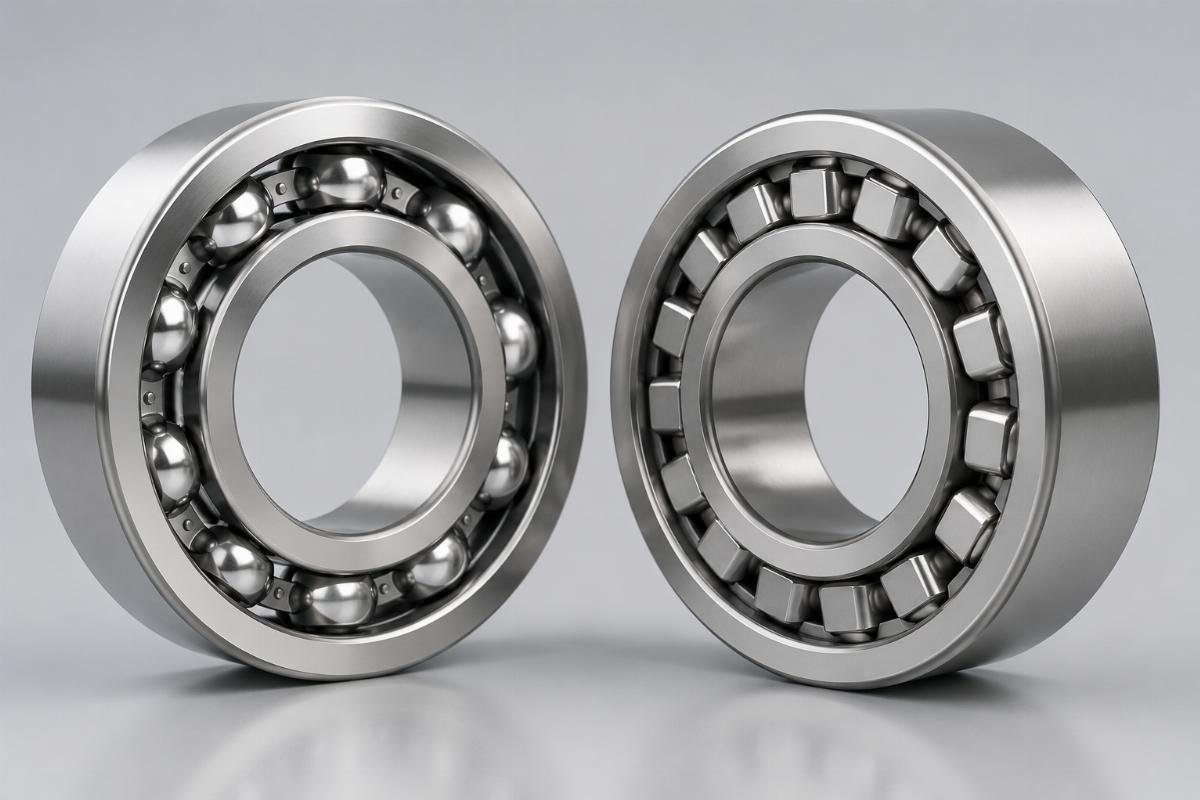
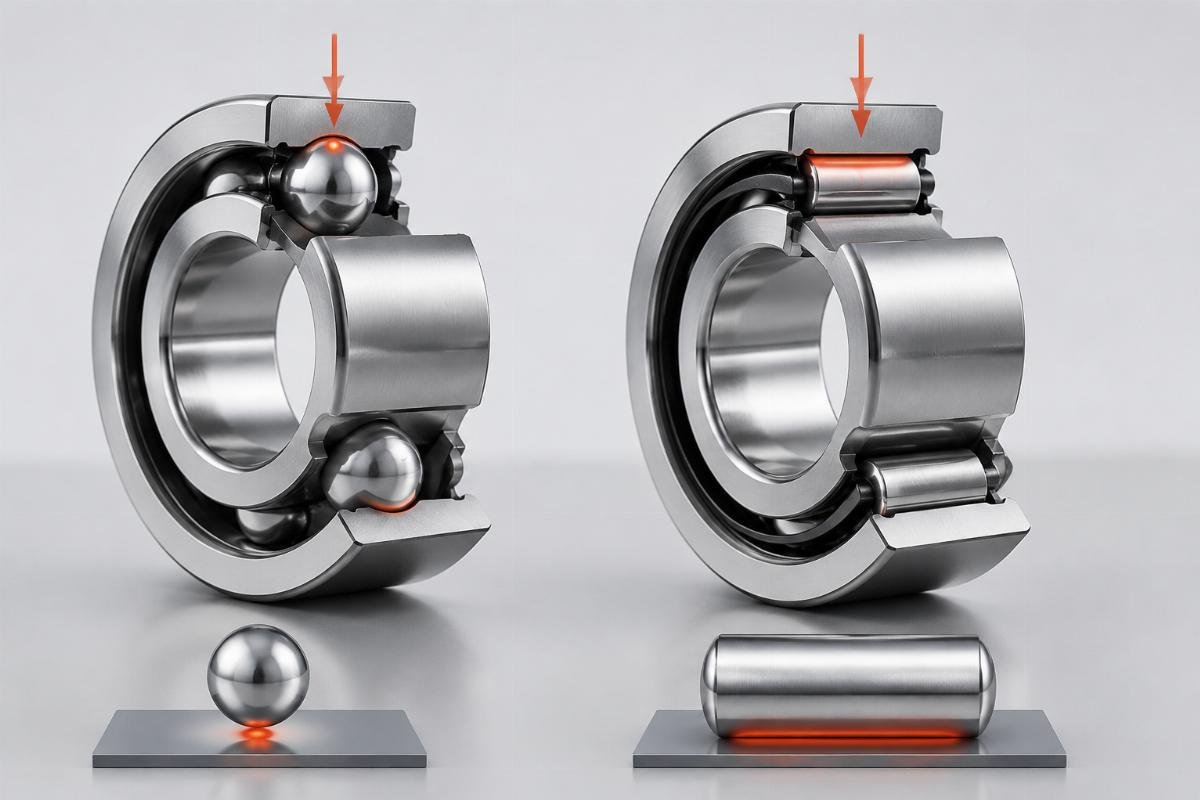
Point contact against line contact is the whole story, and that single difference is what makes each type strong in different industrial settings — which is why the analysis has to be application-specific.
| Performance Metric | Ball Bearings | Roller Bearings |
|---|---|---|
| Contact Type | Point contact (lower friction) | Line contact (higher load distribution) |
| Speed Capability | High-speed optimized (up to 15,000 RPM range) | Typically noticeably lower than equivalent ball bearings |
| Load Distribution | Concentrated pressure on small contact area | Distributed load across longer contact surface |
| Precision Potential | Higher (P4 grade achievable with micron-level runout) | Moderate (better for shock absorption than fine precision) |
| Temperature Resistance | Excellent with ceramic materials (up to 350°C) | Good with steel variants (up to 200°C standard) |
| Misalignment Tolerance | Limited (requires precise shaft alignment) | Superior (spherical designs accommodate shaft deflection) |
Contact mechanics drive everything downstream. A ball touches the raceway at a point, so friction and heat stay low and rotational speed can climb — at the cost of concentrating stress on a tiny area. A roller spreads load along a line, which carries heavier radial and axial force but produces more friction once speed rises.
One European steel mill client was replacing conveyor bearings weekly even though the units were sold as heavy-duty rollers. That conveyor ran at 1,800 RPM, close to the ceiling for the model, and every week of lost output was substantial. The analysis found a speed-load mismatch. We replaced them with hybrid ceramic deep groove ball bearings in a precision class, and the failures stopped while life improved.
The lesson is that a load chart on its own cannot settle the ball-versus-roller call. Speed, precision, temperature and shaft alignment all have to be weighed.
When Ball Bearings Win
Ball bearings are the right tool wherever rotational accuracy and heat control decide product quality and line throughput.
| Application Aspect | Common Mistake | Optimal Approach |
|---|---|---|
| Electric Motor Selection | Using standard roller bearings for high-RPM motors | Specifying deep groove ball bearings with C3 clearance for high-speed applications |
| CNC Machine Spindles | Accepting standard precision grades | Requiring P4 grade angular contact ball bearings with tight radial runout |
| High-Temperature Environments | Assuming all bearings have similar heat resistance | Implementing hybrid ceramic ball bearings for operations above 200°C |
| Food Processing Equipment | Using standard steel bearings | Selecting stainless steel ball bearings with FDA-compliant lubrication |
A wind turbine manufacturer needed P4 angular contact ball bearings for gearbox prototypes. Their previous source could not hold a batch together: radial runout varied from 3.2μm to 8.7μm across a delivery. We added material certificates and dimensional inspection lot by lot, and the full order landed at a consistent 3.2μm. Gearbox noise dropped noticeably and prototype test cycles stretched out.
Where ball bearings are the default choice:
- Deep Groove Ball Bearings – For electric motors and pumps running as fast as 15,000 RPM
- Angular Contact Bearings – Where a CNC spindle must also carry axial load
- Hybrid Ceramic Bearings – For food processing at high temperature, to 350°C
- Self-Aligning Ball Type – Where the shaft is out of line by a small amount
- Thrust Ball Bearings – Low-speed positions with heavy axial load, such as crane pivots
So weigh the question as speed and precision against shock absorption. If the first pair carries more weight, take the ball bearing.
When Only a Roller Bearing Will Do
Roller bearings are unmatched where shock, misalignment and extreme radial force set the operating profile.
| Roller Bearing Type | Key Advantages | Primary Applications |
|---|---|---|
| Spherical Roller Bearings | Self-aligning capability, handles combined loads | Conveyor systems, steel mill rolling stands |
| Tapered Roller Bearings | High radial and axial load capacity | Automotive transmissions, gearboxes |
| Cylindrical Roller Bearings | Excellent radial load handling, high speed capability | Electric motor shafts, machine tool spindles |
| Needle Roller Bearings | High load density in compact design | Agricultural machinery, hydraulic cylinders |
| Thrust Roller Bearings | Handles extremely high axial loads | Presses, marine propulsion systems |
One copper mine in South America lost a mid-six-figure sum in output after fitting counterfeit bearings to its primary crusher. The copies lasted 45 days, then took the line down. We shipped 241/800CAK30/W33 spherical rollers, 800mm bore, with IATF 16949 certification and anti-counterfeit verification. Those units carried dust resistance and shock capacity engineered for mining duty, and ran 18 months — four times the life of the copies.
The selection factors that matter for rollers:
- Spherical Roller Bearings – Pick these where misalignment or heavy shock is present
- Tapered Roller Bearings – Choose for gearboxes that must carry radial and axial load together
- Cylindrical Roller Bearings – Use in electric motor positions with high radial load
- Needle Roller Bearings – Fit them into agricultural components with very little installation space
- Thrust Roller Bearings – For vertical shafts and presses where axial force is heavy
Where load magnitude and shock resistance decide the question, a roller bearing is the only workable choice. Authenticity still has to be verified, because a counterfeit roller in heavy industry fails catastrophically.
How Procurement Avoids a Selection Failure
A five-step selection method, backed by hard supplier verification, removes most bearing failures before they happen.
The method runs like this:
- Load Direction Analysis – Establish whether the duty is radial, axial or combined, working from equipment torque data
- Speed Calculation – Compare measured RPM with the speed rating the maker publishes
- Environmental Assessment – Record temperature extremes, contamination exposure and moisture levels
- Precision Requirement – Set the radial runout and axial clearance tolerance the application needs
- Service Life Expectation – Work out the L10 life that production uptime targets demand
The Brazilian mill from earlier is a textbook procurement failure: spotless certificates and spotless packaging still do not guarantee the right application. That buyer specified C3 clearance, while his caster needed a different internal clearance to absorb thermal growth. Nothing was wrong with the bearing; it was applied to the wrong duty.
To keep selection failures out, a China supplier has to deliver:
- Batch traceability – Each consignment traceable from the plant that made it to the dock that receives it
- Engineering support – Load calculation, L10 life work and failure investigation offered as standard
- Anti-counterfeiting verification – Lot numbers a buyer can check against the maker's own records
- Customization – Clearance, material or precision changes on a lead time that fits the project
- Quality status – ISO 9001 and IATF 16949 cleared, backed by material test documentation
A US food processing equipment OEM shows what a supplier relationship is worth. The company needed stainless cylindrical rollers, FDA-compliant grease included, for a new processing line. Other quotes ran several months for the custom build; our own warehousing put the first order on their dock in four weeks.
What to Demand from a Supplier Beyond the Part
Choosing the supplier matters as much as choosing the type — the best bearing decision fails without dependable supply, documentation and technical backup across the product life.
| Selection Factor | Critical Evaluation Criteria |
|---|---|
| Product Authenticity | Full traceability documentation from manufacturing source to delivery |
| Technical Support | Availability of application engineering, load calculation, and failure analysis services |
| Delivery Capability | Standard model dispatch within 48 hours, emergency shipment options |
| Customization Flexibility | Ability to modify clearance, materials, and precision grades with reasonable turnaround for small batches |
| Quality Certification | ISO 9001 and IATF 16949 compliance with material certification documentation |
We supply compatible replacement bearings for FAG/Schaeffler-series and SKF-series interchange applications, drawn from named plants we audit, with batch-level traceability on every consignment. Stock depth on rare designations — large bores, special precision and clearance pairings, ceramic and stainless — means dispatch in 48 hours where a factory order would run several weeks.
OEM factories that need exact conformance and batch consistency get lot-by-lot precision inspection, laser marking, private-label packing and translated documents. Project suppliers working to fixed delivery windows get certificates of origin, DDP terms and a firm delivery commitment.
The ball-versus-roller decision reaches past the datasheet into supply chain reliability. A China supplier whose batches can be traced, and who brings application engineering to the table, is what keeps a correct selection from turning into a premature failure.
Final Take
Fit the type to the load, the speed, the precision demand and the surroundings. Ball bearings take the high-speed precision work; roller bearings take the heavy load and shock.
Pairing the right type through a traceable China supplier is what prevents premature failure — through a documented selection method, batch traceability and application engineering. Most failures come from the wrong type, not from bad manufacturing, so confirm your supplier ships traceable, documented product and can back the choice with technical support.
Interchange Precision Spec
Key Technical Points
Super-Precision Bearing
DIN 620 / ISO 492
Typical class P2
7020-C-T-P4S
● Compatible replacement bearings for FAG/Schaeffler-series interchange · ● Shockproof packing, vibration controlled · ● Quote with DIN-conformity certification in 24 hours
Quotation for P4/P2 grades delivered in 24 hours.
Share the bearing model or send a technical drawing; the application engineers reply with stock availability, delivery time and the configurations we recommend.
Phone line
+852 9554 0048
Tagged topics
Need a quote for a specific bearing designation? Our engineers reply within one business day.
Request a quote